Practical Summary: How to Effectively Resolve the Conflict Between Company Relocation and Employee's Refusal to Change Workplace
Both business owners and employees have likely encountered situations where companies relocate their offices, only to face resistance from staff opposing the change. Employers worry about potential work stoppages disrupting operations, while employees fear disguised layoffs that could compromise their rights. When these conflicting interests remain unresolved, labor disputes often arise. However, if a company mishandles the relocation process, it risks not only being liable for compensation payments but also damaging its corporate reputation.
Therefore, this paper summarizes how to effectively solve the deadlock of company relocation and employees' refusal to work in the new workplace from the perspective of the enterprise, so as to avoid the risk of paying economic compensation or illegal termination compensation.
I. Case Introduction
[Case 1]: Yang was assigned to Company A in early 2020, with the company's registered address at Lishui Town, Nanhai District, Foshan City. In mid-to-late 2022, Company A relocated to Haizhu District, Guangzhou, in accordance with the "Personnel Transfer Plan" issued by its parent group. The company issued an announcement and negotiated with all employees, promising to maintain their job positions and salary benefits while providing transportation allowances based on rank. Yang received a monthly allowance of 1,000 yuan but refused to accept it, continuing to clock in at the original workplace despite the company's relocation (which had already occurred). During this period, Company A sent Yang both a "Work Transfer Notice" and a "Notice of Deadline for Return to Work," but Yang ignored them and persisted in clocking in. Ultimately, Company A terminated the employment contract, citing Yang's failure to report to the new position as constituting three consecutive days of unexcused absence.
Yang claimed that Company A had unlawfully terminated his employment and thus filed for labor arbitration, demanding 2n yuan in compensation for wrongful termination. The case went through arbitration, first-instance trial, and second-instance trial, ultimately concluding with a mediation settlement in the second instance.
The arbitration award ruled that Company A must pay Yang economic compensation.
Reason: The circumstances in this case meet the criteria under Article 40(3) of the Labor Contract Law of the People's Republic of China, which stipulates that the termination is not unlawful when significant changes in objective circumstances prevent the employer and employee from reaching an agreement on contract amendments. Therefore, pursuant to Article 46 of the same law, the court ruled that Company A must pay Yang economic compensation.
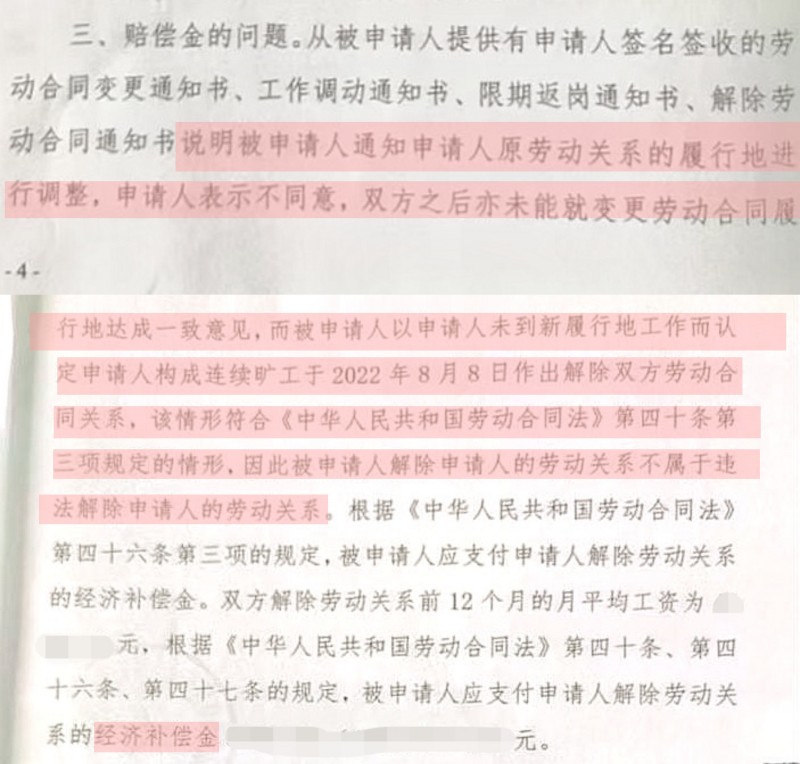
Both Company A and Mr.Yang, dissatisfied with the arbitration award, filed first-instance lawsuits.
The first-instance court ruled that Company A must pay Yang compensation for unlawful termination of the employment contract.
Reason: Company A terminated the employment contract with Mr.Yang for failing to report to the new position, which constituted three consecutive days of unauthorized absence. This termination was unlawful, and the company must pay compensation for the illegal termination.
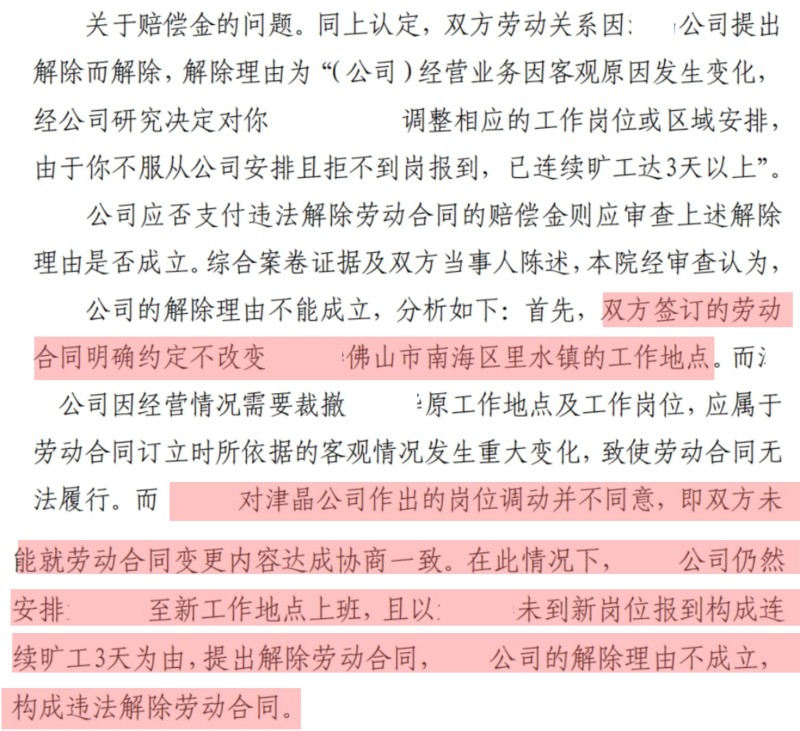
After the first-instance judgment was issued, Company A appealed. However, under the judge's mediation, both parties reached a settlement agreement during the second trial, agreeing to reduce the compensation amount and arrange for Company A to pay it to Yang in installments.
*(As the case was settled through mediation in the second instance without factual reassessment by the appellate court, the author, having represented the company during this phase, remains skeptical of the first-instance judgment. The author maintains that the second-instance trial, if conducted properly, could still provide room for reasoned arguments.)
[Case 2]: Huang joined Company B in January 2020, with the employment contract specifying Room XXX in Liwan District, Guangzhou as his workplace. In October 2024, Company B was required to relocate its entire facility to Lishui Town, Nanhai District, Foshan due to the expiration of its factory lease agreement. Prior to this move, the company had notified all employees in advance about the relocation timeline and location. In September 2024, Company B organized a site visit to the new location for all staff. The company also committed to maintaining employees' job positions and salary benefits while negotiating transportation allowances. For Huang, the company offered a higher monthly transportation allowance of 800 yuan than other employees, which he declined. When Company B proposed arranging work at their physical store, Huang refused, citing inadequate office conditions. Ultimately, Huang formally requested termination of the employment contract.
Afterwards, Huang filed for labor arbitration with the Labor Arbitration Commission, demanding B Company to pay him severance pay. The case went through arbitration and first-instance proceedings (small claims procedure), but both rejected Huang's claims.
The arbitration award rejected Huang's claim.
Reason: Company B's relocation of Huang's workplace falls within its operational autonomy, without causing material changes to working conditions. As an employee, Huang was required to comply with the company's arrangements. Therefore, his decision to terminate the employment contract does not meet the statutory requirements for economic compensation.
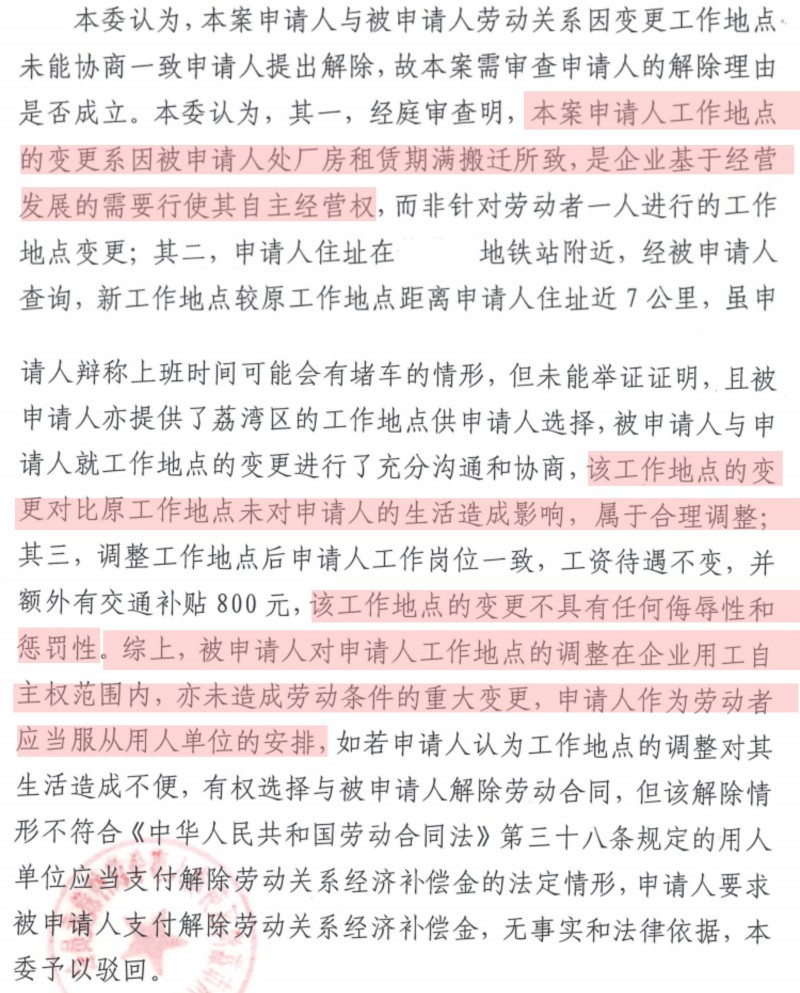
Huang Mou filed a lawsuit to the court.
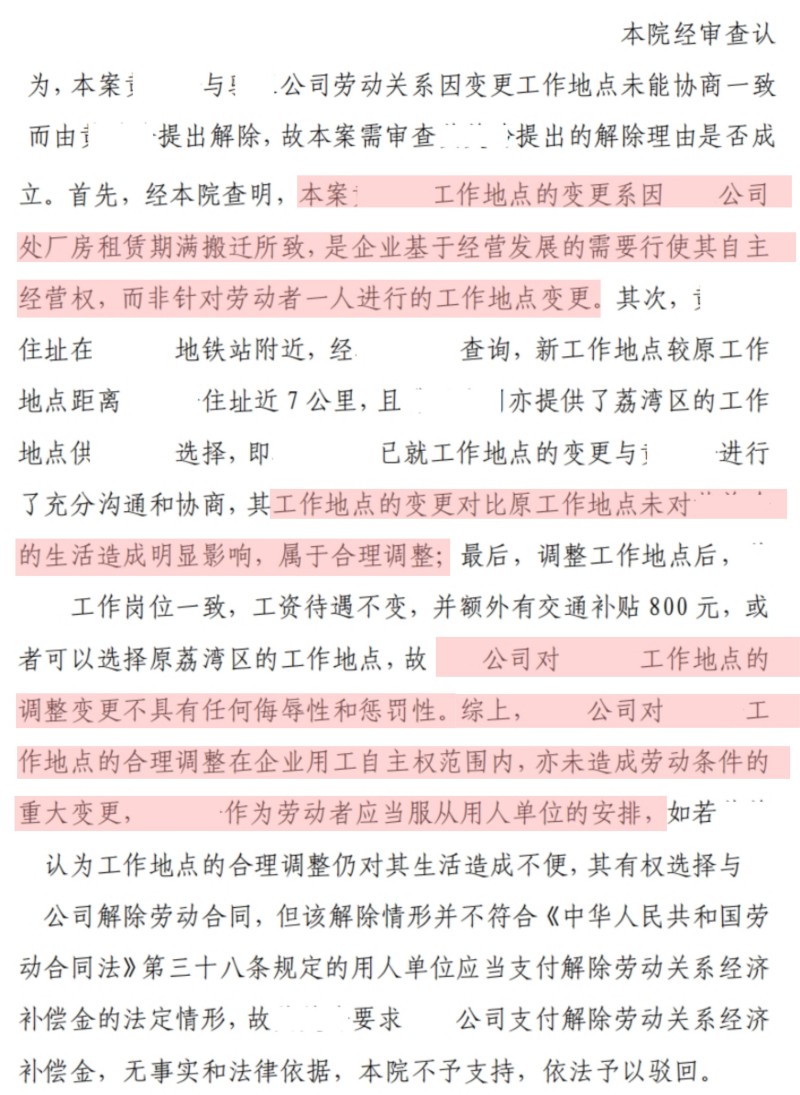
The first-instance judgment rejected Huang's claim.
Reason: Company B's reasonable adjustment of Huang's workplace falls within its employment autonomy, without causing significant changes to working conditions. As an employee, Huang should comply with the company's arrangements. Therefore, his decision to terminate the labor contract does not meet the statutory requirements for paying economic compensation.
This case was adjudicated under the summary procedure, with the first-instance judgment being final and binding.
2. Case Analysis, Comparison and Explanation
Examining these two strikingly similar cases raises a pressing question: Both instances involved relocating workplaces to meet operational needs, with no changes to employees 'positions or salary reductions, and both provided transportation allowances. Yet, why does one case classify the company's actions as unlawful termination, while the other dismisses the employee's claim for economic compensation?
After handling these two cases, I identified two key differences through careful comparison: First, whether the company had adequately communicated and negotiated with employees regarding the change of work location. Second, who initiated the termination of the labor contract and what were the reasons for it?
First, let's address the issue of "employee relocation due to company relocation." Since the workplace is a mandatory clause in employment contracts, changing the workplace constitutes a modification of the contract terms and is recognized as "a significant change in the objective circumstances at the time of contract formation." Legally, this primarily involves Article 40(3) of the Labor Contract Law, which states: "If the objective circumstances relied upon at the time of contract formation undergo significant changes, rendering the contract unenforceable," combined with Article 46(3) of the same law. If such circumstances change significantly, making the contract unenforceable, and if the employer and employee fail to reach an agreement through negotiation, the employer may terminate the contract by giving the employee 30 days' written notice or by paying an additional month's salary, and must provide economic compensation.
It is evident that for workers to claim economic compensation due to their employer's relocation and unwillingness to work at the new location, three conditions must be met simultaneously:
1. The objective conditions on which the labor contract was based have undergone significant changes;
2. The labor contract cannot be fulfilled;
3. The employer and the employee failed to reach an agreement on amending the labor contract through negotiation.
The first and third conditions are relatively straightforward to assess. In judicial practice, the focus is typically on whether a change in workplace location would 'render the labor contract unenforceable.' Case studies show that courts usually consider the following factors to determine if such a change substantially adversely affects the employee's work or life:
1. The distance between the employer's original business location and the new one;
2. Whether transportation is provided;
3. Whether employee dormitories are provided;
4. Whether to adjust working hours to reduce employees' working time;
5. Whether to provide transportation subsidies;
6. Whether to provide housing or rental subsidies.
In such cases, if the employer has implemented the aforementioned measures to mitigate adverse effects on the employee's work and life due to the relocation, or has conducted prior consultations with the employee and provided feasible alternative arrangements, then even if the employer's relocation causes practical inconveniences, it generally does not constitute a material change that would inevitably render the contract unenforceable. This means it does not meet the legal threshold of 'a material change in objective circumstances that prevents the fulfillment of the labor contract.'
Secondly, the identity of the party initiating termination and the rationale behind it are equally critical. In Case 1, although the termination was objectively triggered by the employee's refusal to accept the relocation and report to the new workplace, Company A terminated the employment contract by claiming Yang's failure to report constituted continuous absenteeism and violated company policies. The first-instance court ruled that Company A's termination grounds were unreasonable, thus declaring it unlawful. I believe that if Company A had revised its termination grounds to "the failure to reach an agreement on the relocation of the workplace, and termination pursuant to Article 40(3) of the Labor Contract Law," it might have avoided being deemed unlawful. This serves as a reminder to business owners: The termination grounds stated in employment termination notices must be carefully crafted, as they constitute key evidence for determining whether an employer's termination is justified. Even minor inaccuracies could lead to legal consequences.
In Case 2, the worker is the party seeking to terminate the employment contract. The court must assess whether the employer's relocation significantly affected the worker and whether reasonable compensatory measures were implemented to determine the validity of the worker's termination grounds. If it is determined that the employer's relocation did not cause substantial changes to the worker and appropriate compensatory measures were taken, the employer is not required to pay severance pay for the worker's termination.
III. CONCLUSIONS AND RECOMMENDATIONS
To summarize, when an employer decides to relocate based on operational autonomy, the following measures can help the company effectively resolve the situation and avoid the risks of paying economic compensation for contract termination (if the employee initiates termination) or compensation (if the employer initiates termination):
1. Issue the "Relocation Notice" in advance to inform workers of the relocation time and location;
2. Proactively discuss relocation arrangements with employees, gather their feedback, and formalize the discussions in writing.
3. Develop and publicly disclose a relocation compensation plan. The plan may include provisions such as transportation allowances, complimentary shuttle services, employee housing, flexible working hours, and housing or rental subsidies. These measures aim to minimize workplace and personal inconveniences caused by the employer's relocation, thereby reducing the actual impact on employees.
[Relevant laws and regulations]
1. Article 40 of the Labor Contract Law of the People's Republic of China provides that an employer may terminate a labor contract under any of the following circumstances, provided that it gives the employee written notice at least thirty days in advance or pays the employee an additional month's salary:
(1) Where a worker falls ill or is injured not due to work, and after the prescribed medical treatment period, he is unable to perform his original work or any other work assigned by the employer;
(2) The worker is unable to perform the job, and even after training or a change of position, he still cannot perform the job;
(3) The objective circumstances on which the labor contract was based have undergone significant changes, rendering the contract unfulfillable, and the employer and the employee have failed to reach an agreement on amending the contract terms through consultation.
2. Article 46 of the Labor Contract Law of the People's Republic of China stipulates that an employer shall pay economic compensation to the employee under any of the following circumstances:
(1) The laborer terminates the labor contract in accordance with Article 38 of this Law;
(2) Where the employer proposes to terminate the labor contract with the employee pursuant to Article 36 of this Law and both parties reach a mutual agreement on the termination;
(3) The employer terminates the labor contract in accordance with Article 40 of this Law;
(4) where the employer terminates the labor contract pursuant to paragraph 1 of Article 41 of this Law;
(5) Where a fixed-term labor contract is terminated pursuant to paragraph 1 of Article 44 of this Law, except where the employer maintains or improves the conditions stipulated in the labor contract and the employee refuses to renew it;
(6) termination of the labor contract pursuant to items 4 and 5 of Article 44 of this Law;
(7) Other circumstances prescribed by laws and administrative regulations.
3. Article 9 of the "Guangdong Provincial High People's Court's Answers to Difficult Issues in Labor Dispute Cases" stipulates: 9. How to resolve labor contract performance issues arising from corporate relocation:
When an enterprise relocates due to significant changes in the objective circumstances that formed the basis for its labor contract, the employer must negotiate with the employee to amend the contract terms. If no agreement is reached on the amendments, the employee's request to terminate the contract and the employer's obligation to pay economic compensation for termination shall be upheld. However, if the relocation does not significantly impact the employee and the employer has implemented reasonable compensatory measures (such as providing shuttle services or transportation allowances), the employee's grounds for termination may be deemed insufficient, and the employer is not required to pay economic compensation for termination.
4. The "Minutes of the Symposium on Several Issues Concerning the Trial of Labor and Personnel Dispute Cases" jointly issued by the Guangdong Provincial High People's Court and the Guangdong Labor and Personnel Dispute Arbitration Commission (Yue Gao Fa [2012] No.284) (now repealed but still relevant for reference)
22. Where an employer adjusts an employee's job position and the following conditions are met simultaneously, such adjustment shall be deemed as lawful exercise of the employer's employment autonomy. If the employee claims termination of the labor contract and demands economic compensation on grounds of the employer's unilateral position adjustment, the claim shall not be upheld:
(1) The adjustment of workers 'positions is required by the employer's production and operation needs;
(2) The worker's salary after job reassignment shall be comparable to that of the original position;
(3) It should not be insulting or punitive;
(4) No other violations of laws and regulations.
If the employer changes the worker's position without the circumstances specified in the preceding paragraph, and the worker fails to raise a clear objection for over one year, then the request to terminate the labor contract and claim economic compensation under Article 38(1)(1) of the Labor Contract Law shall not be supported.
5. Article 30 of the "Guidelines on Several Issues Concerning the Trial of Labor Dispute Cases" jointly issued by Foshan Intermediate People's Court and Foshan Labor Dispute Arbitration Commission stipulates: Where an employer adjusts an employee's job position while meeting all the following conditions, such adjustment shall be deemed as lawful exercise of employment autonomy by the employer. In such cases, the employee's request to terminate the labor contract and claim economic compensation pursuant to Item (1) of Paragraph 1, Article 38 of the Labor Contract Law shall not be granted.
(1) The employer's adjustment of the employee's job position is stipulated in the labor contract or specified in the employer's internal regulations;
(2) The adjustment of workers 'positions is required by the employer's production and operation.
(3) The adjusted salary of the worker shall be substantially equivalent to the original position's salary;
(4) It should not be insulting or punitive;
(5) No other violations of labor contracts or labor laws and regulations.


Phone: +86(20)38806196
Postal Code: 510623
Address: Room 4904, Fuli Yingkai Plaza, No.16 HuaxiaRoad,Tianhe District,Guangzhou.
Mobile: +86(20)13922153797
 Website:easystartlawfirm.com
 WeChat Official Account